

The Market Street Cook-Off
Chapter bookThe Market Street Cook-Off
Oskar wants to win his street's cooking competition. But then someone starts spoiling the stalls, and Rafa's family gets the blame.
Part of the plan. 3 sample books, one per age, are free to read.
Made with AI, checked by people
- 8 chapters
- English
About this book
- Age
- Ages 9–12
- Themes
- Mysteries to solve
- Length
- 8 chapters
- Illustration style
- anime
- Language
- English
In this book
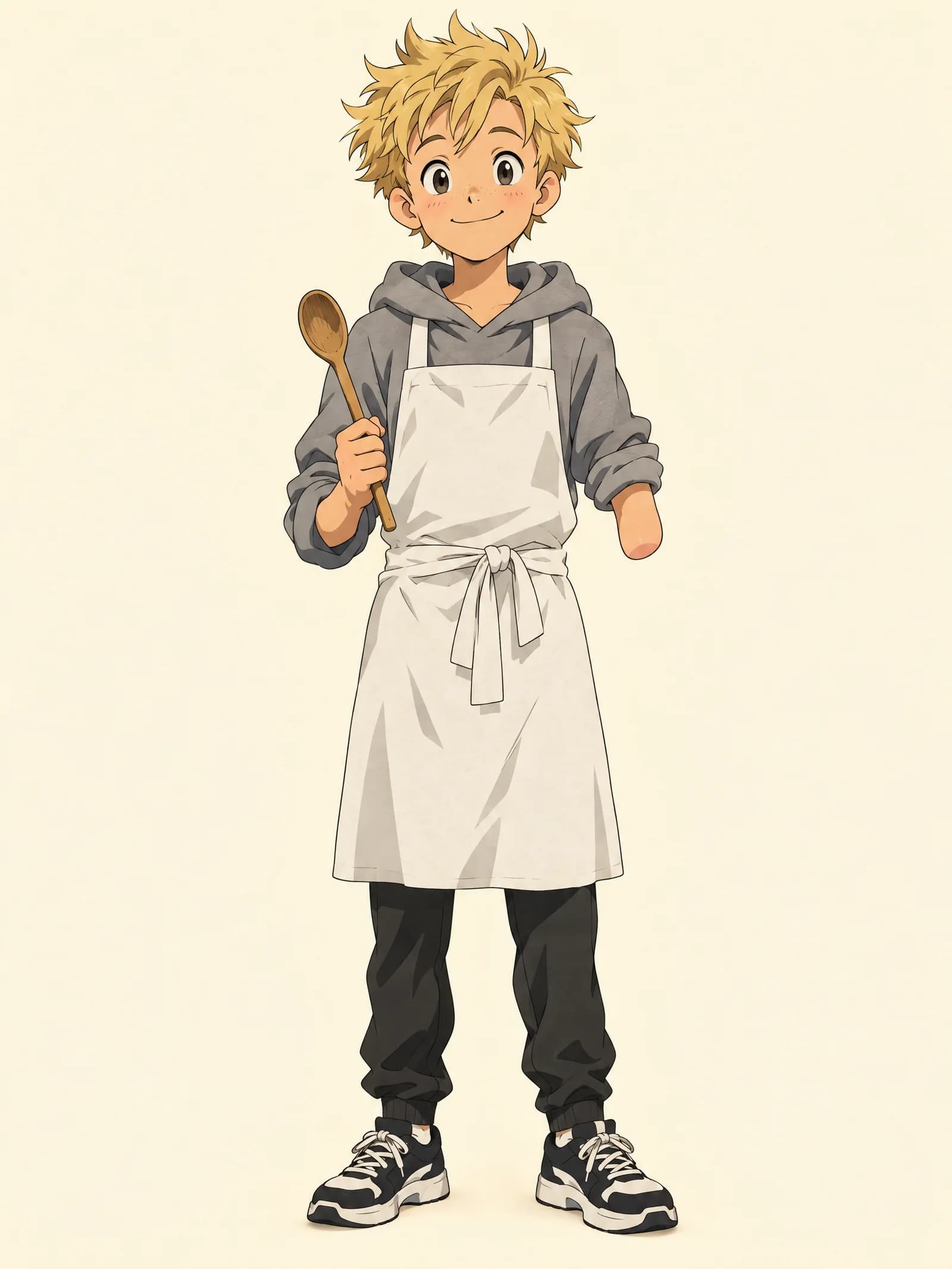 OskarWants to become a head chef, age 11
 RafaThe market's dancer, age 8
Your child becomes the hero of a new story, and they come along. $7.99, read-aloud included, no subscription needed.
Also as a hardcover: order by Monday 30 November. The printed book
This is how the story begins.
Chapter 1
Oskar kneaded the mince so hard that an ordinary bowl would have skated right across the counter by now. This bowl did not budge. Dad had once screwed a heavy clamp to the edge of the counter, and the bowl sat in it as firmly as a post in the ground. Oskar only needed one hand to knead, which was handy, because one hand was all he had. His left arm stopped just below the elbow. He had rolled up that sleeve of his grey hoodie so it wouldn't dangle in the mince.
On the cooker stood the big pan with the dent in its side. Bubble, went the tomato sauce. Bubble, bubble. The kitchen above his parents' shop was small, and every corner of it smelled of onion and garlic. There was a red splash on the white tiles behind the cooker. Oskar had seen it, of course. That was for later.
He didn't look at the recipe. The card hung in the middle of the noticeboard, old and yellow, with a drawing pin through it, and Oskar knew every word by heart. Grandma Lien had written it out long ago in slanting, spiky letters that all leaned a little to the right, like grass in the wind. In the bottom right corner was a brown stain. That was from the day Grandma laughed so hard she dropped the ladle on the card. Just above the stain, underlined twice, was the most important line in the whole recipe: one spoon of salt. No more.
Last summer Grandma Lien had given him the card at the kitchen table, her fingers wrapped round his hand. "My hands are getting too stiff for meatballs," she had said. "You roll them. You've got a better tongue than I have." Oskar had nodded as if it was nothing special. That evening he had checked his drawer three times to make sure the card was still there.
He pulled a lump of mince from the bowl and rolled it under his palm on the chopping board, round and round, until he had a ball the size of a ping-pong ball. With the end of his left arm he nudged it aside to make room for the next one. That way it went quickly. After a quarter of an hour, twenty balls sat in a row, as neat as eggs in a box. Oskar slid them into the pan one at a time. Plop, went the first one into the sauce. Plop, went the second. At the twentieth, a drop splashed onto his white chef's apron, right where his heart was.
Oskar took the wooden spoon in his right hand, blew on it and tasted. He closed his eyes. He raised his eyebrows. He rolled the sauce over his tongue the way the judges did every year at the long table on the stage. "Hmm," he said in a deep, grand voice. "My dear chef, the onion is lovely and soft. But the pepper is shy."
Oskar had an opinion about everything, and he usually said it out loud. He had once told Mum her macaroni tasted like wet cardboard. Since then, Oskar had cooked on Tuesdays. He had told the soup man at the stall downstairs that his soup tasted like warm washing-up water. The soup man waved a lot less cheerfully these days when Oskar walked past.
Mum's voice came up from the bottom of the stairs. "Oskar! You can smell it all over the shop! There's a man down here asking what you're making." Oskar leaned over the banister. "Tell him it's not finished!" he called. Mum laughed. "He wants the recipe!" she called up. Oskar looked over his shoulder at the yellow card on the noticeboard. "It's a secret," he called back. "It's Grandma's."
He went to the window above the sink and looked down. In Market Street, two men on ladders were stringing bunting between the houses. Right at the end of the street, someone was hammering away at a wooden stage. In three days the final of the cooking competition would be held there, and this year Oskar was in it for the first time, the youngest of them all.
He knew exactly what people would say when he climbed onto that stage. Ah, the boy from the shop. Isn't he sweet. Oskar did not want to be sweet. He wanted them to take a bite and say nothing at all for a moment, because it was that good. Sometimes he pictured it the other way round: a meatball rolling off his spoon, over the edge of the judges' table and away down the street. Whenever he did, his tummy went as tight as a drum.
Back at the cooker, he sprinkled a pinch of pepper into the pan and stirred three times. Bubble, went the sauce, sounding a bit more pleased with itself. Oskar tasted again and held the spoon still in front of his mouth. "Nearly good enough," he said out loud, towards the stairs.
"You said that yesterday!" Mum called from below. Oskar licked the spoon clean. "Yesterday it was nearly-nearly!" he shouted back.
Chapter 2
Oskar had just turned the gas down a notch when someone in the street below started to grumble. He leaned over the sink and looked out of the window. The soup man was standing at his stall with a pan in his hands, and people were already gathering round him. "Sour!" cried the soup man. "My whole stock! It was fine last night!"
Oskar shouted down for Mum to keep an eye on the sauce. He ran down the stairs and through the shop, the wooden spoon still in his right hand. Outside, it smelled of fried onions and sun-warmed stones. The new bunting fluttered between the houses, and down the middle of Market Street the stalls stood in a row under their striped awnings.
Around the soup stall, people were whispering. "It's the vegetables," said a woman with a shopping bag. "Everyone gets them from the same stall." A man nodded and glanced sideways at the vegetable stall further along, where the wooden crates were stacked higher than his head. That stall belonged to Rafa's family. Every cook in the street bought their vegetables there: the leeks, the carrots, the onions, and the tomatoes in Oskar's sauce too.
"That's rubbish," said Oskar. Everyone turned round. His ears went hot, but he stepped forward anyway. "When did you make the stock?" he asked the soup man. "Yesterday," the soup man grunted. "It stood under the awning all night with the lid on." Oskar nodded, the way a real detective nods. "Can I taste it?" The soup man hesitated, but he held out a spoon. Oskar closed his eyes and raised his eyebrows, just as he did in the kitchen. "It's sour, all right," he said. "But to be honest, it didn't taste of much yesterday either."
The soup man's face went red, from his neck all the way up to his eyebrows. "First washing-up water, and now this," he said. He pointed down the street with his ladle. "Off you go."
Things went no better at the baker's stall. The baker stood among her glass jars of sugar and salt, wiping flour off her hands. "Did you see anyone near the soup stall last night?" Oskar asked. "I was home by six, love," said the baker. She held out a currant bun. "Here. For the shock." Oskar tucked the wooden spoon behind the string of his apron and took the bun. He took a bite and chewed. He chewed again. "It's a bit dry," he said. "It would be better with more currants." The baker took the bun back out of his hand. "Then you won't be wanting it," she said.
Oskar stood in the middle of the street with an empty hand and a crumb on his white chef's apron. He pulled the wooden spoon out from behind the string again. Two cooks, two cross faces, and he knew exactly as little as before. "Nice work, chef," said a voice behind him.
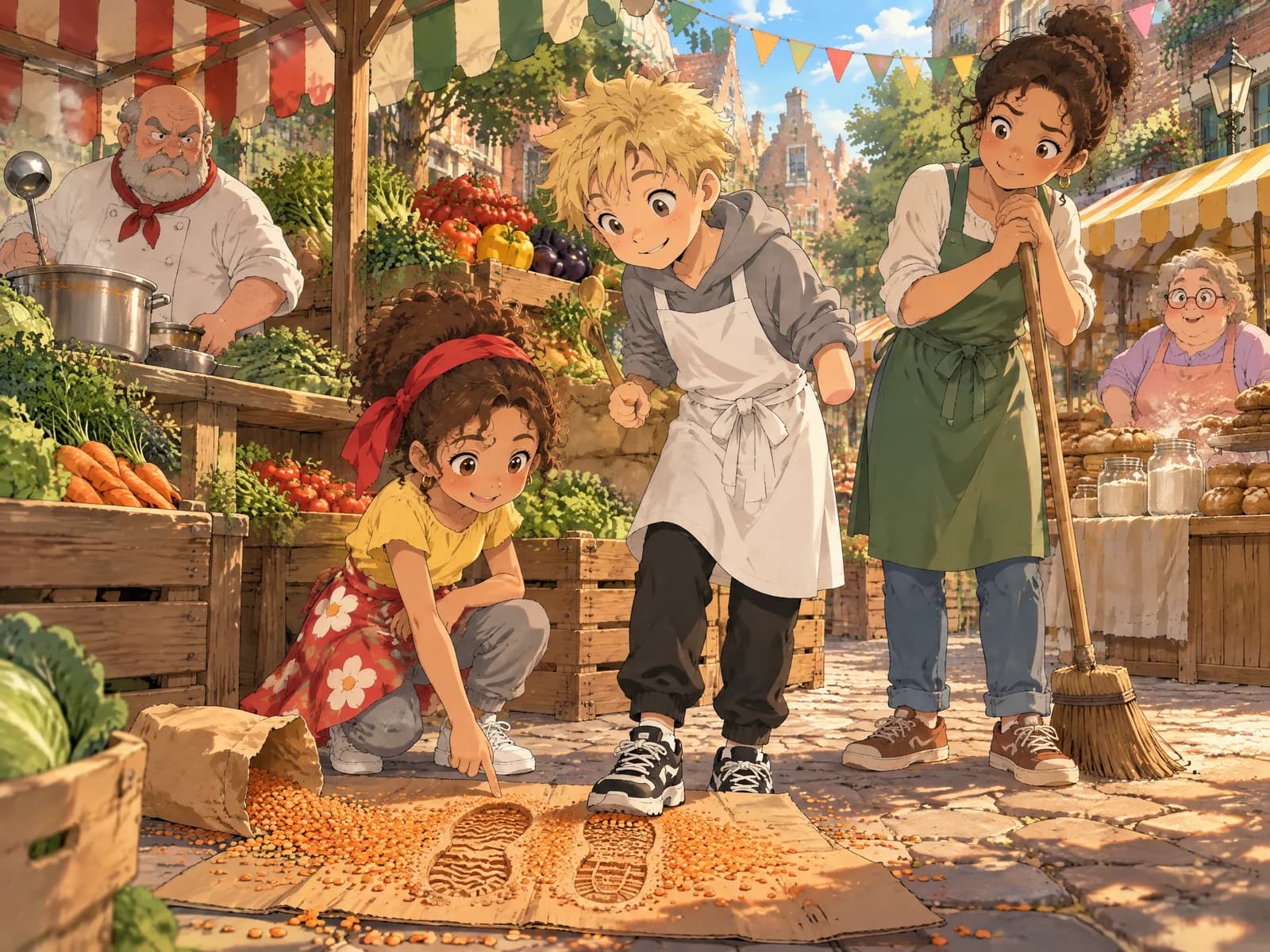
It was Rafa. She came dancing out between the crates of the vegetable stall, her big brown curls bouncing with every step, a red scarf tied in among them. "Two people cross in five minutes," said Rafa. "That's a record." She twirled round a stack of apple boxes, hopped over a crate of cauliflowers and caught a sack of lentils on the edge of the counter with her elbow. The sack tipped over, and lentils rained down onto a flat piece of cardboard behind the stall, grey with dust from the sacks. Rafa just kept dancing. Crunch, went the lentils under her shoes. Crunch, crunch.
"Rafa!" Her mother came out from behind the counter with a broom. "Look at that. Footprints everywhere. As if we haven't had enough trouble today." Rafa stopped. Her shoulders drooped. She looked over at the soup stall, where people were still whispering. "They think it was us, don't they," she said quietly.
"I don't believe a word of it," said Oskar. "Your tomatoes are the best in the whole town. And I'm not just saying that." Rafa lifted one corner of her mouth. "You never say anything just to be nice," she said.
She crouched by the cardboard and pointed at a print in the dust among the lentils, full of little waves. "That's me," said Rafa. "Put your foot next to it." Oskar stepped carefully into the dust beside the lentils. His print was full of little squares, like a waffle. "See?" said Rafa. "Every shoe has its own pattern. Mum's got diamonds. Dad's got stripes, but they're nearly worn away on one side, because he walks lopsided."
Oskar looked at the two prints side by side, the waves and the waffle. He had never known there could be so much on the bottom of a shoe. Rafa stood up and folded her arms. "If someone's doing this on purpose," she said, "then they're walking around somewhere. And I'm going to find their shoes." Her mother pushed the broom into her hands. "First you're going to find the lentils," she said.
Read next
The whole library- Ages 9–12Exciting

The Key to the Observatory
Reading bookThe dome won't turn, the comet comes only once in a hundred years, and the one person who knew how to open it has been gone for thirty years.
- Ages 9–12Magical

When the Clocks Ran Backwards
Reading bookMira the witch only wanted to give the village more time for the summer festival. Now every clock is running backwards, the same day keeps starting over, and only Nour has noticed.
- Ages 9–12Funny
Grandpa Ko's Walker
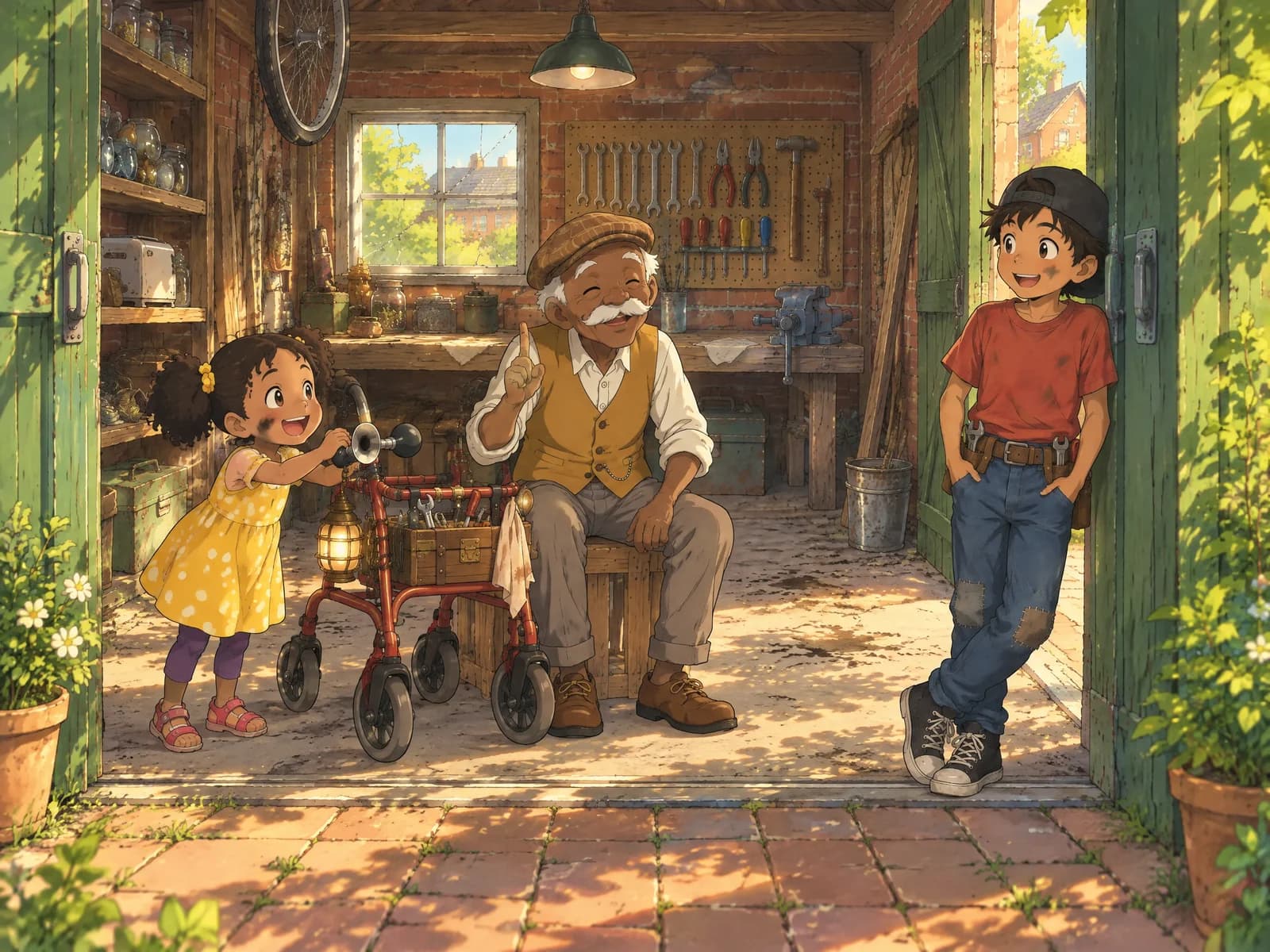
Chapter bookGrandpa Ko is eighty and rebuilds everything, especially his own walker. For the neighbourhood Inventions Market, he and his young neighbour Ilyas dream up something big.

A book starring your child
Personalised bookA one-of-a-kind present: your child drawn into a personalised children's book. $7.99, read-aloud included.
How it works
This book was written and illustrated with AI, and then checked by people.